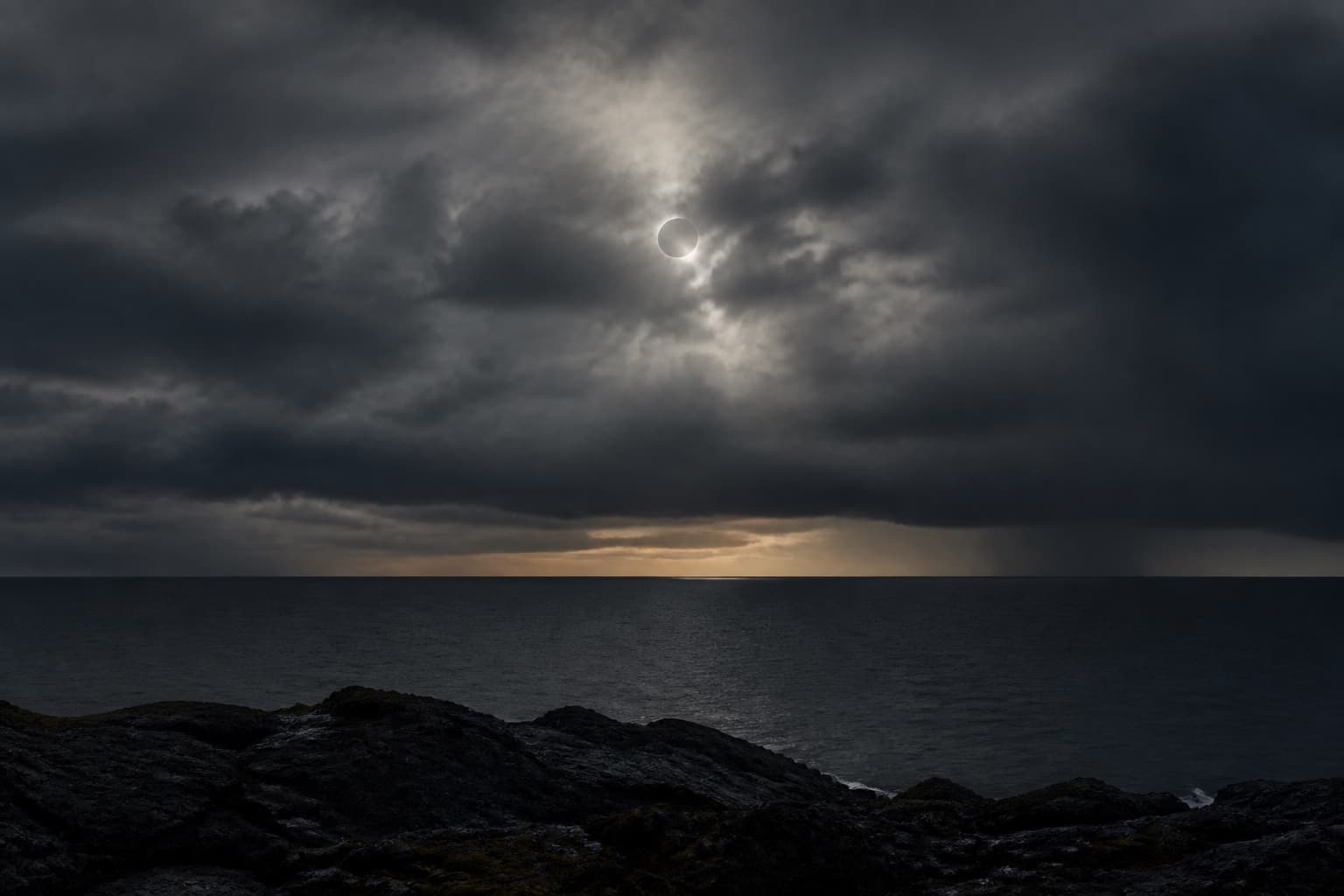
On 12 August 2026, one total solar eclipse produced two very different experiences. Across much of Spain, people watched the Moon cover the Sun and saw the corona emerge. In Reykjavík, cloud and rain obscured the solar disc. Those gathered outside Hallgrímskirkja saw daylight fall away, then return, without getting the clear view for which they had waited.
The contrast does not offer the easy lesson that persistence always earns a reward. It offers something more useful: when we have prepared carefully and the outcome still lies beyond our control, sisu means acknowledging the disappointment while keeping our judgement, our relationships and our capacity to choose what happens next.
One lunar shadow, two very different arrivals
NASA's account of the eclipse shows the path of totality crossing Greenland, Iceland, northern Russia, the North Atlantic, Spain and a small part of Portugal. At most locations inside that path, totality lasted less than two minutes; even the maximum was under two and a half minutes.
The Associated Press report from Europe captured the contrast. In Spain, millions made their way to towns, beaches and open ground for the country's first total solar eclipse in more than a century. Cheers rose as the light changed and the Sun disappeared.
At much the same time, rain was falling in Reykjavík. Hundreds of people in waterproof clothing still gathered in front of Hallgrímskirkja. The cloud made the Sun itself almost impossible to see, but darkness arrived all the same. When the first light returned, that crowd cheered too.
Both groups reached the place they had chosen. They did not receive the same sky.
For families in Hong Kong, this distinction is familiar even outside astronomy. We can research a school choice, plan a holiday around the weather, practise for a performance or prepare for an important conversation. Care can improve the odds, but it cannot turn an uncertain world into a contract.
Let disappointment be real before looking for a lesson
Some eclipse watchers will have booked accommodation years ahead, studied maps and forecasts, acquired equipment and travelled a long way for less than two minutes in the Moon's shadow. Cloud does not move aside because a person has been diligent.
In that moment, one of the quickest forms of comfort can also be one of the least helpful: “It doesn't matter. The experience was what counted.”
It does matter. A long-awaited sight did not appear. That is a genuine loss, even if it is not a tragedy.
Mature sisu does not immediately rename disappointment as gratitude, nor does it demand a cheerful attitude on schedule. It leaves room for an honest sentence:
I prepared as well as I could, and the thing I hoped to see did not happen.
That acknowledgement is not self-pity. It is how we avoid using optimism to escape reality. Only when the loss has been named can we consider what the experience still means without pretending it was the outcome we wanted.
This matters particularly with children. When adults rush to make every setback educational, a child may hear that the acceptable response is not the truthful one. Before asking what they learnt, we can first show that we understand what they missed.
Preparation still matters, even when it cannot secure the result
Careful preparation cannot buy clear skies. It is still worthwhile.
Preparation improves the chance of being in the right place at the right time. It helps a family manage transport, crowds, unfamiliar surroundings and the needs of each person in the group. It creates options when conditions change. Most importantly, it protects people from risks that enthusiasm can make easy to overlook.
NASA's eclipse safety guidance is clear that appropriate solar viewing protection is required during the partial phases and immediately before and after totality. Ordinary sunglasses are not a substitute. Children require close adult supervision, and no photograph or glimpse is worth unsafe viewing.
The wider boundary matters too. A changing forecast does not justify a rushed drive, entering restricted ground or separating from the group to chase a break in the cloud. Adults remain responsible for weather, traffic, equipment, location and the decision to stop.
This is not a footnote to an adventurous experience. It is part of the meaning:
Courage does not cancel rules, and commitment does not give us permission to take careless risks.
We can be responsible for our research, communication, equipment and choices. We cannot be responsible for the cloud itself. Keeping those categories separate prevents disappointment from quietly turning into self-blame: “If I had worked harder, perhaps this would not have happened.”
This is where sisu parts company with simply pushing through
Sisu has no exact one-word English equivalent. In the editorial framework used by SISU Hong Kong, it points towards the ability to see a difficult, tiring or uncertain situation clearly and find the next appropriate action.
“Appropriate” matters more than “keep going”.
If the forecast changes early enough, the appropriate action may be to move to a safer viewing location. If roads are congested or conditions deteriorate, it may be to stop chasing the eclipse. If the cloud never opens, it may be to put the equipment away and share the strange change in light with the people beside us. If emotions need time, the next step may simply be to admit that today was deeply disappointing and travel home safely.
None of these choices guarantees a satisfying ending. Sisu is not the belief that the cloud must eventually clear. It is the refusal to hand our judgement over to frustration when it does not.
That also means knowing when persistence has become fixation. Extra effort is not automatically wise merely because much has already been invested. The money spent, the kilometres travelled and the hopes raised cannot make an unsafe next action reasonable.
Sometimes courage continues. Sometimes courage changes course. Sometimes it ends the attempt. Sisu is present in the quality and responsibility of the choice, not in how dramatic it looks from outside.
Children do not need an instant inspirational speech
When a family plan falls apart, adults often move quickly into meaning-making. We want a child to feel better, so we point out what was still beautiful, useful or educational. The intention is caring. The timing may not be.
A child who has waited a long time may first need someone to say, “You were really looking forward to this, so of course you are upset.”
Once the feeling has been given room, reflection becomes possible. Until then, a lesson can feel like a request to repeat an adult's preferred conclusion.
The eclipse is not an argument for manufacturing hardship. Everyday life already supplies enough uncertainty: a cancelled outing, a missed opportunity, an illness before a performance, a team result that effort could not determine. Our role is not to make the disappointment disappear or to praise it as secretly beneficial. It is to help children notice several truths at once:
- being responsible is not the same as being in control;
- an unwanted result is not proof of personal failure;
- feelings can be real without making every decision for us;
- asking for help, changing the plan and stopping can all be capable choices.
This approach also protects the relationship. A child does not have to perform resilience for an adult. They can be disappointed and still be accompanied.
A four-question family card for after the shadow
The next time a family plan does not work out, wait until everyone is settled enough to talk. Then use these four questions—not as a test, but as a way to separate facts, feelings, responsibility and choice.
- What were we hoping would happen? Name what was lost before trying to make it smaller.
- Which parts of the preparation were ours to take responsibility for? Notice the research, communication, equipment, safety arrangements and shared tasks that were completed.
- Which changes were never ours to decide? Weather, another person's choice, a last-minute rule or an unexpected event need not be mistaken for personal failure.
- What is one appropriate next step now? Continue, adjust, ask for help, pause or finish—all may be valid, provided the reason is clear and the people involved are cared for.
The questions do not require every disappointment to become a story of growth. Sometimes the most accurate conclusion is simply that something important was missed. The card only helps a family avoid confusing an outcome with a person's worth or confusing persistence with the only courageous response.
For younger children, one question at a time may be enough. For adults, the same card can expose an uncomfortable habit: treating everything outside our control as evidence that we failed to prepare.
What we really practise is living with uncertainty
We often picture perseverance as a straight line: choose a goal, overcome the obstacles and arrive. Real life is closer to travelling into the path of a lunar shadow. We can study the map, but we cannot move the clouds. We can bring the right eye protection, but we cannot extend totality. We can invest deeply in an experience, but the world has not promised us the result in return.
The more dependable form of strength is therefore not confidence that events will follow our plan. It is the knowledge that, if they do not, an honest and responsible response remains available.
The corona beneath a clear Spanish sky was extraordinary. The minute of darkness under Icelandic rain does not have to be declared an equal gift. Doing so would flatten the difference that made the day painful for some and joyous for others.
It can remain what it was: a missed view, a shared moment and a reminder that preparation and control are not the same thing.
We cannot decide what the sky will give us. We can still decide how to stand beside one another—and where to go after the light returns.
That is not a way of beautifying the outcome.
It is sisu.