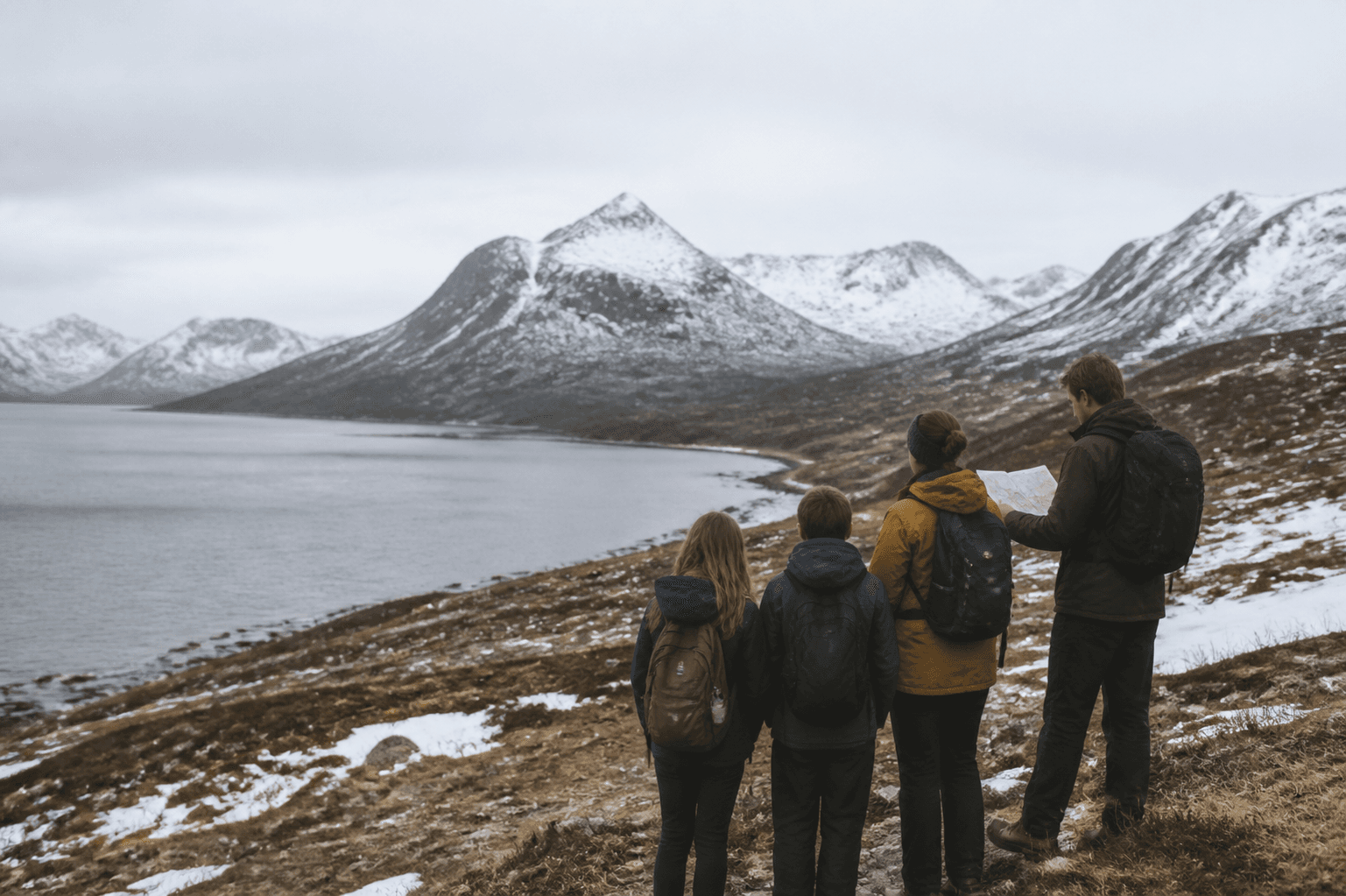
Sisu can be explained.
We can describe it as the capacity to find an appropriate next action when difficulty, fatigue or uncertainty are already present. We can also explain that it is not blind persistence: courage, judgement, responsibility, self-awareness, mutual support and recovery all belong in the picture.
But if sisu remains only a beautiful definition, it remains distant from life.
The Sisu Rally begins with another question:
Can a family move beyond knowing the word and enter a real journey in which they notice how they meet difficulty, make choices and find a next step together?
Some capabilities cannot be taught only through explanation
Children hear messages such as “Be brave”, “Do not give up” and “Take responsibility” from an early age. The messages are not necessarily wrong, but outside a concrete situation they can become answers that adults expect children to repeat.
A genuinely difficult moment does not first ask whether a child remembers the right phrase. It brings incomplete information, different opinions, fatigue, unsuccessful attempts and the need to revise a plan. The child must work out what is happening and recognise that a choice may affect other people.
The value of real-world learning is therefore not that it takes a child somewhere harsher.
It allows an abstract capability to meet a situation that calls for action.
Why the form of a rally?
The word rally often suggests competition and speed. The Sisu Rally is not intended to be defined by who reaches a finish first.
The rally form matters because it brings together a route, a shared purpose, a sequence of changes that require a response and a team that needs to move together.
The route is not simply a line connecting attractions. It is a learning structure that keeps asking questions.
A family prepares, then meets things that preparation could not completely remove. It makes a plan, then notices when changing conditions call for new judgement. Each person acts, while also paying attention to whether the rest of the team can still move well together.
In these moments, sisu begins to become more than a definition.
Route: uncertainty becomes real
In a classroom exercise, someone has usually selected the problem and may already know the answer. A route introduces a different kind of reality: Where are we now? What matters next? Does the original method still suit the situation?
Uncertainty does not mean confusion, and it must never mean deliberately placing participants in danger.
A responsibly designed route needs clear boundaries and available support. Within those boundaries, it can leave enough room for observation and judgement to have genuine value.
The educational possibility lies in that balance—not in maximising unpredictability.
Mission: action gains a purpose
When a journey is organised only around places, the family’s main responsibility may be to appear at the next stop on time. A mission asks participants to become involved in something shared.
A meaningful mission connects preparation, division of work and choice to one understandable purpose. A child is not simply told where the next stop is. They have an opportunity to understand what the team is trying to accomplish and why their contribution matters.
The mission does not need manufactured drama.
Its value is that participants can see a relationship between action and result.
Choice: children become more than followers
Agency does not appear because an adult tells a child to “be independent”.
Children need a real portion of choice inside appropriate boundaries: which problem to address first, how to divide the work, which workable method to try, or when the team should reassess.
If adults have already decided every answer and children are only invited to guess the approved one, the appearance of choice changes nothing.
Meaningful choice also brings an understandable result. The result need not be a punishment. The team may need more time, may need to reorganise or may need to acknowledge that the first approach did not work.
The child can then discover that their judgement is not decorative. It matters—and because it matters, it carries responsibility towards the people travelling with them.
Team: a family moves from management towards shared experience
One of the central propositions of The Sisu Rally is not to send a child away to be made tougher. Parents and children enter the experience together.
In ordinary family life, adults often remind, arrange and solve, while children wait for the next instruction. A shared mission can temporarily alter that pattern. A child may contribute an observation or suggest a direction; a parent may practise not being the first person to provide every answer.
Shared experience does not mean identical roles.
Adults remain responsible for safety, care and the boundaries that cannot be transferred. Going together means that, beyond those responsibilities, a child can participate meaningfully—and the family can see how each person responds when the answer is not immediately known.
Result: responsibility stops being abstract
Responsibility is not created by saying, “You need to be responsible.”
When a child’s choice genuinely affects time, division of work or the team’s next move, responsibility becomes an experience. The child can see when an observation helped and can take part in correcting an approach that did not work, rather than waiting for an adult to erase every consequence.
Results must remain understandable and proportionate to the participant’s capacity. An adult cannot transfer serious risk or major consequences to a child in order to manufacture a lesson.
The purpose is not to catch someone making a mistake.
It is to let action, result and adjustment remain connected.
Reflection: arrival is not the end of the journey
Completing a task does not mean that learning has automatically taken place.
The family needs time to return to specific moments. When did the journey feel hardest? What information shaped a decision? Who noticed something the others had missed? How did the team respond when a method failed? Who offered help, and who found the courage to ask for it?
Reflection is not designed to make participants repeat the conclusion, “I learnt perseverance.”
It helps each person build language for their own experience and allows discoveries from the route to travel back into family life.
The next time a child meets uncertainty, they may not remember every detail of the journey. They may remember a pattern:
I did not know the answer then either. We still found a next step.
Five design intentions—not five promised outcomes
The Sisu Rally is intended to create conditions in which five kinds of discovery may become possible.
Courage
Approaching something unfamiliar within reasonable boundaries, rather than waiting for fear to disappear completely.
Agency
Discovering that one’s observation and choice can affect what happens, rather than being present only to follow instructions.
Responsibility
Recognising that choices exist within relationships and being willing to respond to the results they create.
Resilience
When an approach fails, being able to rest, adjust, receive support and decide on another step.
Connection
Allowing parents and children not only to talk about growth, but to share an experience that is worth returning to together.
These are design intentions. They are not a guarantee that attending one journey will create a fixed change.
Every child, family and experience is different. A responsible education brand should not describe complex human development as an outcome that can be delivered on schedule.
It is not a race or a hardship test
The Sisu Rally does not define success by speed.
The fastest person may not have observed most carefully or made the most responsible decision. A team that adjusts its pace, notices a companion and acknowledges the need for help may demonstrate a more mature form of sisu than one that forces the original plan to continue.
Nor should the rally be packaged as an experience that “makes children suffer”.
Difficulty can have educational value only when the purpose is clear, boundaries are responsible, support is available and the experience can be reflected upon. Suffering itself is not a curriculum.
Rest, a changed route and a request for assistance can all be responsible actions when they respond honestly to the person, team and environment.
Lapland is not a travel backdrop
Within the brand proposition, Lapland offers more than scenery. It provides a real environment whose scale, light, weather, distance and patterns of movement may make ordinarily invisible choices easier to notice.
But an environment does not educate automatically, and magnificent imagery cannot substitute for preparation.
The season, route, clothing, equipment, accommodation, transport and support for any actual journey must be described from confirmed operational information. Until those facts exist, SISU Hong Kong can explain the design philosophy but must not imply that specific arrangements have been completed.
This distinction protects both trust and the integrity of the learning idea.
Trust means saying what is known—and what is not
A high-quality experience should not ask parents to rely on atmosphere.
Before making a participation decision, families need verified answers about dates, fees, age suitability, activity demands, leaders, relevant qualifications, insurance, medical support, emergency procedures, transport, accommodation and cancellation arrangements.
None of those facts can be inferred from this essay. They cannot be replaced by a broad assurance that a team is “professional”.
When details have not been confirmed, the honest action is to invite questions and registration of interest—not to fill the space with information that merely looks complete.
A journey towards one’s own sisu
The Sisu Rally is not ultimately intended to give a family a louder motivational slogan.
It offers a quieter possibility:
When life does not provide a prepared answer, can a parent and child look clearly at what is happening, make a choice, respond to the result, support one another and then take another step?
We cannot promise a life without headwinds.
But a shared experience that has been carefully designed and honestly reflected upon may allow a child to recognise:
Even when something is hard, I can still act.
I do not have to do everything alone.
The next step does not have to be perfect—and I can take part in choosing it.
A journey into the real world.
A journey towards one’s own sisu.